

Arriving in Benin without the right documents can turn your trip into a stressful ordeal at the immigration counter. Whether you are flying into Cotonou Cadjehoun Airport (COO) or crossing a land border, knowing the exact Benin entry requirements saves time and prevents denied entry. This guide covers every document, health certificate, and step you will face at the border – so you can pass through immigration with confidence.
What Documents Do You Need to Enter Benin?
Every traveler entering Benin must present a specific set of documents at the immigration checkpoint. The requirements apply whether you arrive by air, land, or sea.
Passport
Your passport is the single most important document. Benin immigration enforces these rules strictly:
- Validity: At least 6 months remaining from your date of arrival in Benin
- Blank pages: Minimum 1 blank page for entry and exit stamps (2 recommended)
- Condition: No torn pages, water damage, or detached cover – damaged passports may be refused
If your passport does not meet these criteria, the immigration officer will deny you entry – there are no exceptions or on-the-spot extensions. Renew your passport before traveling if it expires within 6 months.
Approved e-Visa or Visa
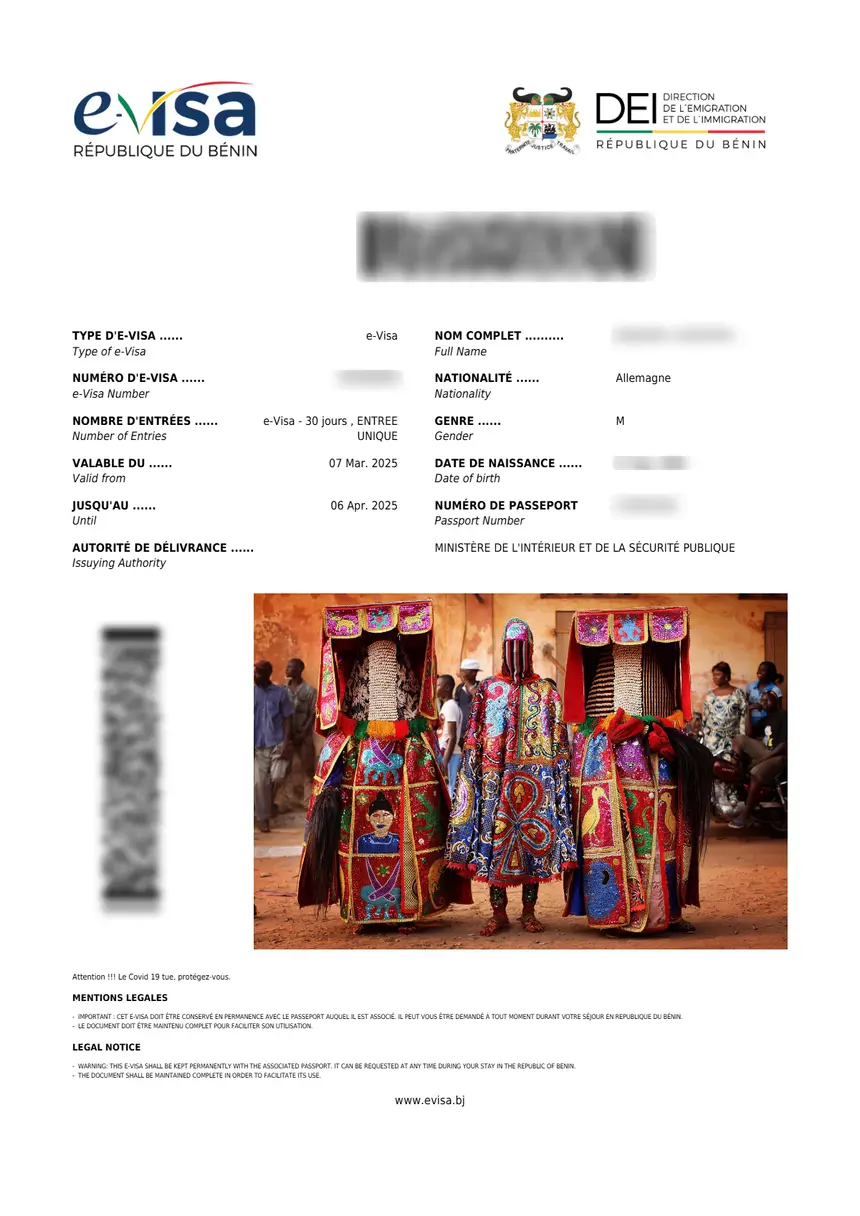
Unless you are from a visa-exempt country, you must hold a valid visa to enter Benin. For most nationalities, the easiest option is the Benin e-Visa, which you apply for online at the official portal evisa.bj before your trip.
You do not need to visit an embassy. The e-Visa is delivered by email and must be presented at the border – either printed on paper or displayed on your phone or tablet.
Important: Benin does not offer visas on arrival for first-time applicants. You must have your e-Visa approved before boarding your flight. Airlines will check your visa at departure and may refuse boarding without it.
Who Is Exempt from a Visa?
Not everyone needs a visa to enter Benin. The following groups can enter visa-free:
- All African Union member state passport holders – visa-free entry for up to 90 days
- ECOWAS citizens – free movement under the Economic Community of West African States protocol
- Select bilateral agreement countries – citizens of nations with reciprocal visa-waiver agreements with Benin
Travelers from the United States, United Kingdom, Canada, India, Australia, and all EU/Schengen countries need a visa.
Yellow Fever Vaccination Certificate
This is a non-negotiable entry requirement. A valid WHO Yellow Card (International Certificate of Vaccination or Prophylaxis) proving yellow fever vaccination is mandatory for all travelers entering Benin, regardless of nationality.
Key rules:
- You must be vaccinated at least 10 days before arrival
- The certificate must be the original WHO Yellow Card – photocopies or digital photos may be refused
- Immigration officers will check this document at the border – carry it in your hand luggage, not in your checked baggage
- Children over 9 months old also need the certificate
No yellow fever certificate means no entry. There are no exceptions, and there is no option to get vaccinated at the airport.
What Happens at Benin Immigration? Step by Step
Understanding the arrival process removes the anxiety of entering a new country. Here is exactly what to expect when you land at Cotonou Cadjehoun Airport or arrive at a land border crossing.
Step 1: Deplane and Proceed to Immigration
After exiting the aircraft, follow the signs to the immigration hall. At Cotonou Airport, the walk is short and well-marked. You will join one of the queues – typically separate lines for nationals and foreign visitors.
Step 2: Present Your Documents
When you reach the immigration counter, hand over:
- Passport – opened to the photo page
- Printed e-Visa (or digital copy on your device)
- Yellow fever certificate (WHO Yellow Card)
The officer will verify your passport validity, check your visa status in the system, and inspect your yellow fever certificate. Have all three documents ready before you reach the counter – fumbling through bags slows the line and frustrates the officer.
Step 3: Biometric Data Collection
Benin immigration may collect your fingerprints and take a photograph at the counter. This is standard procedure and takes about 30 seconds. The data is used for security screening and border management.
Step 4: Entry Stamp
If everything checks out, the officer will stamp your passport with:
- The date of entry
- Your permitted length of stay (matching your visa type – 30 or 90 days)
Check the stamp before walking away. Make sure the date and permitted stay are correct. Errors are easier to fix at the counter than later at an immigration office.
Step 5: Collect Baggage and Clear Customs
After immigration, proceed to the baggage claim area. Once you have your luggage, you will pass through customs. Benin operates a standard customs system:
- Green channel: Nothing to declare (most tourists)
- Red channel: Goods to declare (large amounts of currency, commercial goods, restricted items)
Customs officers may randomly select passengers for bag inspection. This is routine and usually brief.
Land Border Entry Requirements
If you are entering Benin overland from Togo, Nigeria, Burkina Faso, or Niger, the same core requirements apply:
- Valid passport (6+ months validity)
- Valid visa (e-Visa is accepted at all official border crossings)
- Yellow fever certificate
- Entry stamp from the Benin border post
Tips for Land Border Crossings
- Use official border posts only – informal crossings are not recognized and will not provide entry stamps
- Carry cash – some land border posts may not have card payment facilities for any fees
- Bring photocopies of your passport, visa, and yellow fever certificate – border officials sometimes keep copies
- Cross during daylight hours – many border posts operate limited hours and some close at night
- Be patient – land border processing can take 30 minutes to 2 hours depending on traffic and staffing
Customs Rules: What You Can and Cannot Bring
Benin has standard customs regulations. Knowing what is allowed prevents problems at the border.
Allowed Without Declaration
- Personal clothing and toiletries
- Electronics for personal use (laptop, phone, camera)
- Up to €5,000 or equivalent in cash without declaration
- Gifts valued under the duty-free allowance
Must Declare
- Cash exceeding €5,000 (or equivalent in other currencies)
- Commercial goods or samples
- Large quantities of electronics (suggesting resale)
- Medications (carry a doctor’s prescription for controlled substances)
Prohibited Items
- Narcotics and illegal drugs – severe penalties, including imprisonment
- Firearms and ammunition – require advance authorization from Beninese authorities
- Pornographic material
- Counterfeit goods
- Endangered species products (ivory, certain animal skins) under CITES regulations
Health Requirements at the Border
Beyond the mandatory yellow fever vaccination, there are a few health-related items to know about.
Yellow Fever (Mandatory)
As covered above, the WHO Yellow Card is required. Benin is in the yellow fever endemic zone, and the vaccination protects both you and the local population.
COVID-19
As of March 2022, Benin has lifted all COVID-19 entry restrictions. You do not need proof of vaccination, a negative PCR test, or a quarantine period to enter the country.
Other Recommended Vaccinations
While not checked at the border, health authorities recommend the following vaccinations for travel to Benin:
- Hepatitis A and B
- Typhoid
- Meningitis
- Rabies (for rural travel)
- Routine vaccinations (MMR, tetanus, polio) up to date
Consult a travel health clinic at least 4 to 6 weeks before departure.
Common Reasons for Denied Entry at Benin Borders
Understanding why travelers get turned away helps you avoid the same mistakes.
| Reason | How to Avoid |
|---|---|
| Passport expires within 6 months | Renew before traveling |
| No yellow fever certificate | Get vaccinated 10+ days before arrival |
| No valid visa | Apply for e-Visa at evisa.bj before your trip |
| Visa does not match passport details | Double-check name spelling and passport number on e-Visa |
| Passport damaged or unreadable | Replace damaged passports before travel |
| Overstayed previous Benin visa | Resolve any overstay issues before re-entering |
What If You Are Denied Entry?
If Benin immigration denies you entry, you will be:
- Held in the immigration area until a return flight is available
- Required to purchase a return ticket at your own expense
- Deported back to your country of origin or last departure point
There is no appeals process at the border. Prevention is the only reliable strategy – make sure all your documents are in order before you travel.
Tips for a Smooth Entry into Benin
Follow these practical tips to breeze through immigration:
- Carry documents in hand luggage – do not pack your passport, visa, or yellow fever certificate in checked baggage
- Print your e-Visa – while digital copies work at some checkpoints, a printed copy is universally accepted
- Arrive with local currency – West African CFA franc (XOF) is the local currency; have small bills for taxis and tips
- Know your accommodation address – immigration officers may ask where you are staying; have the hotel name and address ready
- Dress neatly – while there is no dress code, a presentable appearance can make a difference at the immigration counter
- Stay calm and polite – answer questions directly, do not argue, and follow instructions
FAQs About Benin Entry Requirements
Do I need a return ticket to enter Benin?
While not always checked, immigration officers may ask for proof of onward or return travel. Having a return ticket or confirmed onward booking is strongly recommended. If you are traveling overland, a bus ticket to a neighboring country can serve as proof of onward travel.
Can I enter Benin with a digital copy of my e-Visa?
Yes, a digital copy displayed on your phone or tablet is generally accepted. However, carrying a printed copy is recommended as a backup – some border posts, especially land crossings, may prefer a paper copy.
What if my yellow fever certificate is expired?
A yellow fever vaccination is considered valid for life by the WHO since 2016. Your certificate should not have an expiry date if issued after 2016. If your older certificate shows an expiry date, consult a travel health clinic about getting a new certificate or booster.
How long can I stay in Benin with an e-Visa?
The stay duration depends on your visa type: 30 days for the single-entry and multiple-entry 30-day visas, or 90 days for the multiple-entry 90-day visa. The permitted stay is stamped in your passport upon entry.
Can I extend my stay once I am in Benin?
Yes. You can apply for a visa extension at the Directorate of Emigration and Immigration in Cotonou. Apply before your visa expires – overstaying results in fines, detention, or future entry bans.
Do children need their own visa and yellow fever certificate?
Yes. Children of all ages need their own passport and visa. Children over 9 months old must have a yellow fever vaccination certificate. Apply for the child’s e-Visa separately using their own passport details.
Is there a duty-free allowance when entering Benin?
Travelers can bring personal effects, up to 200 cigarettes or 50 cigars, 1 liter of spirits, and gifts within the duty-free limit. Cash exceeding €5,000 (or equivalent) must be declared. Commercial goods always require customs declaration.
Can I enter Benin through a land border with an e-Visa?
Yes. The Benin e-Visa is accepted at all official land border crossings, not just the airport. The same requirements (passport, visa, yellow fever certificate) apply at every entry point.
What happens if I overstay my visa in Benin?
Overstaying results in fines upon departure, possible detention, and potential bans on future entry into Benin. If you need more time, apply for an extension at the immigration office in Cotonou before your visa expires.
Do I need travel insurance to enter Benin?
Travel insurance is not a mandatory entry requirement for Benin. However, it is strongly recommended. Medical facilities in Benin are limited, and evacuation for serious conditions can be extremely expensive. Comprehensive travel insurance covering medical emergencies and evacuation is a wise investment.
Summary
Entering Benin is straightforward when you have the right documents. The three essentials you must carry are:
- Valid passport with at least 6 months remaining and blank pages
- Approved e-Visa (or qualifying visa exemption) obtained before arrival
- Yellow fever vaccination certificate (WHO Yellow Card)
Present these at the immigration counter, have your biometrics taken if requested, get your entry stamp, and you are in. No surprises, no stress.
Apply for your Benin e-Visa online at the official portal evisa.bj at least one week before your trip to allow for processing time.
This guide is for informational purposes. Entry requirements can change without notice. Always verify the latest rules on the official Benin e-Visa portal at evisa.bj or with your nearest Beninese embassy before traveling.